Monday, April 8, 2013

Cancer fighting Database

Posted by Brad Haymore

 
Imagine a database designed specifically to help doctors fight cancer.  CancerLinQ is that database, and its prototype has just emerged on the market. CancerLinQ will collect and analyze information from cancer care that is given to millions of patients.  The database will combine the information collected from patients, expert guidelines, and other evidence found to generate real-time guidance for doctors.  Doctors will be able to then receive quality feedback on how to help their personal patients.

CancerLinQ performs certain functions:


1)Real-time data collection,
2)Clinical decision support,
3)Data mining & visualization,
4)Quality feedback


Why is such a database needed? 

Today when a doctor encounters a problem he has never dealt with before, he goes to his literature for answers and will also asks his colleagues for advice.  With CancerLinQ, this same doctor could access the database and analyze real time findings in millions of patients.  The personal identity of patients would be removed in the database, but their life saving information would not. 

This is an innovative way that IT is helping to improve healthcare and medicine.  IT allows doctors to collaborate in ways that were unheard of before and to use their best practices to fight diseases such as cancer.  Innovations like this database could speed up the availability of real time data to doctors to use on problems they are facing today.  The timeliness of information in the fight of cancer is essential.  Good information available now is much better than great information available when it’s too late.


Sources:


Green IT. Contradicting E-waste.

Published by: Tyler Avery

Countering the E-waste post, this entry pertains to the Green initiatives of Information Technology. Similar to most other Green actions, IT is no different. So what is Green IT? The official terminology refers to environmentally sustainable computing. Call it Green IT, Green computing or ICT sustainability, in a nutshell, it has two main objectives. 1) to shrink the negative impacts of IT and 2) use IT to help save the environment. 

Green IT is all around us. In researching this post, I found out that sustainable computing has greatly increased without my knowledge or consent. For instance: wireless transactions. I recently received a notice from my utility provider that it would be in my best interest to go paperless. Not being keen to wireless transacting due to the commonality of internet fraud and theft, [thanks to this class] I decided not to do so.  However, it was noted that companies are making the move to cut down on environmental waste. Huge internet giant, Google just shelled out $200 million to invest in wind turbines in Texas. More on that here

Energy efficiency tops the action-item list for the initiative. Yes, it is important to control the E-waste landfill, but what I found to be most gripping, was another infographic here. Striking me as informative and interesting, I researched some of the most common things we college students do now, that, if altered could impact the Green IT campaign.

Some good facts to know…
By turning off your computer each night or when not in use (i.e. lunch times, weekends, when in meetings at night) for a year you save as much energy as it takes:
  • to run a clock radio for 1,392 weeks
  • to make 9,280 bags of microwave popcorn
  • to wash 464 loads of washing
  • to use your blow dryer for 5,568 hours
  • to vacuum for 464 hours
  • to produce 3,480 plastic bags
  • to run your microwave 24 hours a day for a week
  • to boil your kettle for 24 hours a day for 268 days 
I also discovered a list of 10 key facts that will 'make your head spin' here, as well as very descriptive infographics via pinterest here.

What do you, the reader, think about Green IT? Even more so, what are you willing to do about minimizing your carbon footprint? 


http://www.greenitweek.org/learn/news-a-articles/185-what-is-green-it
http://chemicallygreen.com/going-green-an-infographic-guide-to-cost-effective-living/
http://www.goinggreentoday.com/blog/10-green-facts-that-will-make-your-head-spin/
http://pinterest.com/bennuworld/green-infographics/

Tuesday, April 2, 2013

Smart Drugs: Nanotechnology in Medicine

Published by Daniel Powell

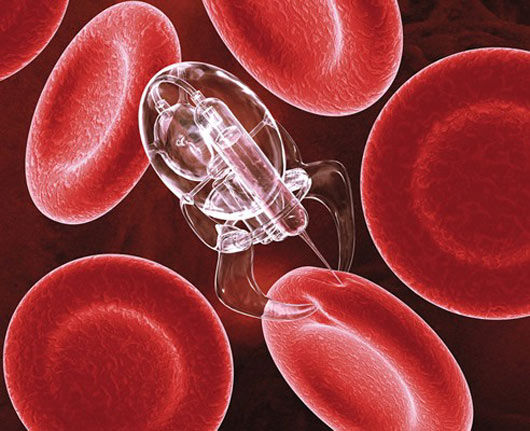
My first encounter with the concept of nanotechnology was in Michael Crichton's Prey.  While the idea of a swarm of hybrid organic-mechanical particles learning to cooperate and destroy other organisms for self-preservation is a bit far-fetched, nanotechnology is not!

Nanotechnology, simply put, is engineering on a very small scale.  To be exact, nanotechnology operates at a molecular and atomic level.  Nanotechnology is applicable across numerous scientific fields and disciplines.  The implications of nanotechnology are so big that in 2000 the U.S. government as created the National Nanotechnology Initiative.  The NNI is a collaborative effort by twenty-six federal agencies to further the research, development, and regulation of nanotechnology.

One such collaborative efforts is with the National Cancer Institute to channel nanotech research and development from the laboratory to the clinic, where it can be used to develop newer and more effective methods of diagnosis and treatment for cancer.  One application is the use of nanotechnology in defending cancer treatments against rejection by the immune system.  Another application aids in more targeted treament by joining drugs with polymer nanoparticles which are attracted to specific proteins often found in cancer cells.  More in-depth descriptions of nanotechnology treatments can be found here.

While it is still an emerging field and very much in the research and development stage, the applications of nanotechnology in medicine are very evident and will only grow and become more exciting in the next few years.


Sources:
http://www.nano.gov/initiatives/commercial/industry-collaborations

http://www.understandingnano.com/cancer-treatment-nanotechnology.html