My first encounter with the concept of nanotechnology was in Michael Crichton's Prey. While the idea of a swarm of hybrid organic-mechanical particles learning to cooperate and destroy other organisms for self-preservation is a bit far-fetched, nanotechnology is not!
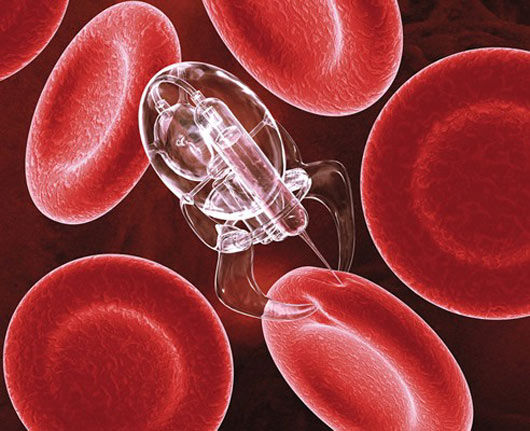
One such collaborative efforts is with the National Cancer Institute to channel nanotech research and development from the laboratory to the clinic, where it can be used to develop newer and more effective methods of diagnosis and treatment for cancer. One application is the use of nanotechnology in defending cancer treatments against rejection by the immune system. Another application aids in more targeted treament by joining drugs with polymer nanoparticles which are attracted to specific proteins often found in cancer cells. More in-depth descriptions of nanotechnology treatments can be found here.
While it is still an emerging field and very much in the research and development stage, the applications of nanotechnology in medicine are very evident and will only grow and become more exciting in the next few years.
Sources:
http://www.nano.gov/initiatives/commercial/industry-collaborations
http://www.understandingnano.com/cancer-treatment-nanotechnology.html

Nano-tech is incredibly awesome. There are a lot of positives listed here which is always good. It seems as though if the government is interested in its development then they are probably seeking to eventually use them as a weapon. Has any of your research indicated any sort of dark side to this technology?
ReplyDeleteNano-tech is rapidly developing I read an article that nano-technology is able to be implanted so that doctors can scan the chip and pull up a patient's entire medical records. I have also seen where the use of nano-chips are being used to repair weak calls and help in other cases like heart conditions. I just wonder if this technology causes any kind of harm to patients or is it so benign they cannot tell?
ReplyDeleteNanotechnology is one of the most important research and development frontiers in modern science. It was originally used to define any work done on the molecular scale, or one billionth of a meter. At nanometer length scale, the properties of a material such as its melting point, its electronic and optical properties will change
ReplyDeletekokou Dansou
I agree with everyone else that nanotechnology is pretty impressive, but what are the downsides of it? I mean I am assuming there isn't a clear way to actually remove them from the body or keep them from malfunctioning. With a power technological advance like this, nations could realistically have more than nuclear weapons to fear. Power would greatly be determined on who could perfect the art of these chips. I also feel security risk would escalate as well. If records could really be stored on these chips who is to say someone cant easily stream your info from them.
ReplyDeleteSteven made a good point. I personally don't want them inside my body. It could be beneficial for some, but personally, I'm going to stay away.
ReplyDeleteI think that this could be very beneficial to the medical field and could really help doctors out, but as mentioned before, what are the downsides of this device being in your body? Also, where does it attach in the body and will it stay in your body for the rest of your life. Another concern I have is what type of other information can this device collect such as does it collect the information the doctor requests or can it continually collect different information that the doctor wants information for? But overall, I feel that this could be beneficial, but may not for everyone.
ReplyDelete-Lauren Gorowski
Most of my reading on the issue has indicated what Kokou said in his comment. Elements' characteristics are manipulated to achieve a desired effect. The link below explains how bonded gold and platinum molecules are used to manipulate the oxidation level of the platinum and reduce side effects in platinum cancer therapy. I'm certain the government has its motive in weaponizing nanotechnology, however I have not seen anything indicating that in my research.
ReplyDeletehttp://www.understandingnano.com/cancer-therapy-platinum-gold-nanoparticles.html
This is interesting. Technology is just getting better and better. I can't believe how they would come up with such micro technology to trace or look into cancer. It just surprises me, but I also agree with the other people because everything has a downside to it.
ReplyDeleteKawg Yang